Let’s be honest: one of the greatest perks of being a flight attendant is the schedule. Being able to prioritize certain destinations for layovers, having 12 days off a month (sometimes even more), choosing to work with friends, but also getting incredible surprises when waiting for a call from Crew Scheduling. If you, too, dream of becoming an Air Transat Flight Attendant, here are a few pointers to help you better understand this world—one that might seem complex at first glance, but opens up a world of possibilities.
A quick aviation lexicon
Before diving into schedule management, here is a little glossary to help you understand the dialect of the trade.
Crew Scheduling / Crew Sched
This is the team responsible for completing crews and assigning pilots, flight directors, and flight attendants so that flights depart with a full crew on board and on time.
Reserve
Having a reserve schedule means “working on call,” i.e., remaining available to head to the airport upon request.
Block Schedule
You will often hear flight attendants say “my block” or “I have a block.” This simply means that this person has a set schedule composed of specific flights.
Bid
You will hear our crew use this word even more often! It is essentially raising our hand for a specific schedule or flight when we submit our requests, which are then used to build the schedule for the following month.
Two types of schedules
As explained in the lexicon above, there are two types of schedules:
- Reserve
- Block
The first, reserve, means we must be available during certain periods to answer the call from Crew Scheduling. AM Reserve is from midnight to noon, and PM Reserve is from noon to midnight. As soon as a need arises, flights are assigned based on the seniority of the flight attendants on reserve and the number of hours worked.
There is a guarantee of paid reserve hours; if the period worked exceeds the base guarantee, the overtime hours are paid as well. By its very nature, the reserve schedule can offer us magnificent surprises to dream destinations. You need a certain adaptability and an appreciation for spontaneity to fully enjoy these shifts!
The second, the block, concerns crews who are assigned specific flights in advance. Destinations, flight hours, layover times, and days off are therefore clearly defined ahead of time. But there is always the possibility of swapping flights among ourselves, dropping certain flights to get extra days off, or picking up extra flights to work overtime hours.
Flight attendant schedule management
All crew members are responsible for submitting their respective requests for days off or flights for the creation of their schedules, following the monthly deadline. Using a computerized points system, we build a priority scale based on our preferences and needs.
Flight attendants on a reserve schedule simply need to indicate their preference between AM and PM reserve, along with their desired days off.
Crew members on a block schedule, however, must organize their requests with a bit more precision, as many criteria are taken into consideration:
- Days off;
- Preferred destinations;
- Colleagues we would like to work with;
- The type of flights desired (short or long-haul);
- The type of aircraft;
- Etc.
Our schedule is published a few days before the end of the month, and from then on, we can start tweaking it our own way, making swaps, picking up extra flights, etc.
The importance of seniority
In aviation, seniority is a key factor in many facets of our professional lives. From vacation selection to schedule management, everything comes back to seniority.
At the very beginning of our careers, most flight attendants will be “on reserve.” Because of this, it is possible that certain requested days off may not be accepted. Why? They may have already been awarded to colleagues with more seniority.
In aviation, as elsewhere, there are adjustment periods.
It is a job that requires a great capacity for adaptation and flexibility, because it can be hard to miss a family party or that dinner with friends you were looking forward to because you ultimately have to go to work. By giving yourself a little time, you get used to it, you organize yourself differently, and so do the people around you. Fortunately, we have colleagues who are good as gold, making it always a pleasure to work!
Our job allows us to discover Europe with our colleagues or to invite our parents, our life partners, or even our friends for a weekend in Rome or Lisbon… Needless to say, we quickly forget the days off we didn’t get and the Christmas parties we missed. We find our reward in other ways.
After a few years, or even a few months, a block schedule is awarded to us. As the saying goes, that’s when the fun begins!
As soon as we gain a bit of seniority, the contours of our career form more clearly; we taste more freedom and have more control over our daily lives. It must be said that we can also get some beautiful surprises when receiving those famous block schedules. Like being able to go to Marrakech, Barcelona, and Glasgow all in the same summer with a colleague who has become a best friend. And getting paid for it, too!


Creating magical memories
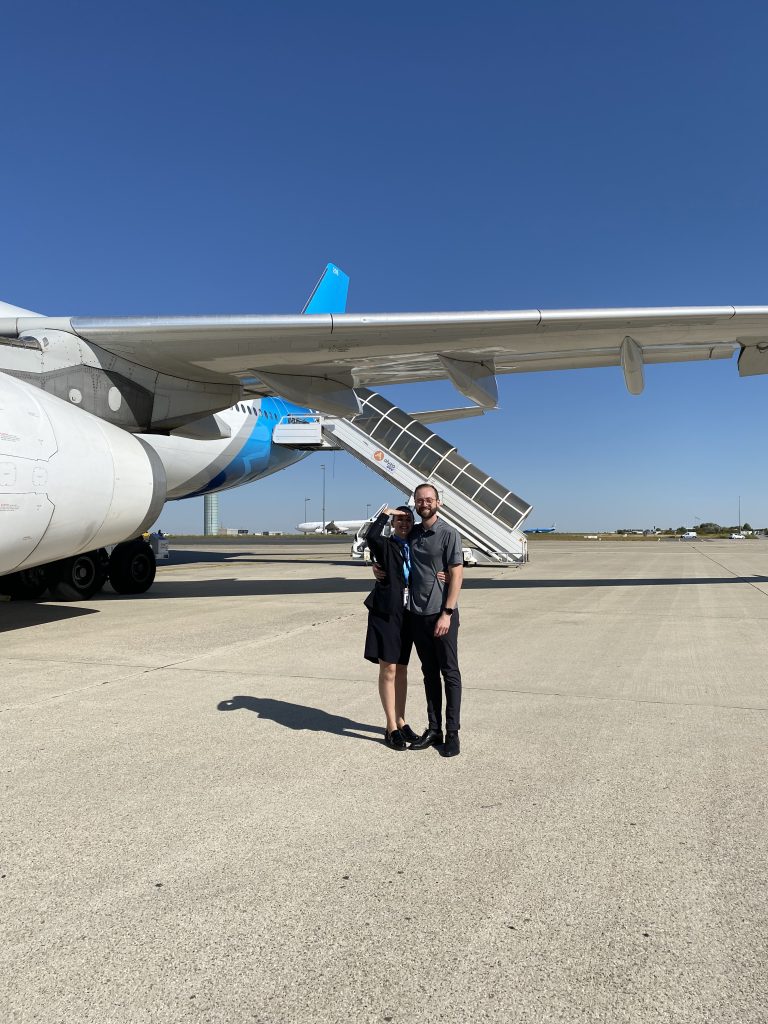
I will always remember the day I was able to meet up with my parents in Paris with my boyfriend, who had been able to come along. Magical. It is precisely for these kinds of priceless memories that I love my job.
And then, blocks also allow us to “bid” to work with our favorite colleagues to roam the skies and discover the destination together before heading back.
These priceless moments don’t just happen later on. My very first flight as a flight attendant was between Toronto and Lamezia Terme, Italy, with a 48-hour layover at the destination. My crew invited me for a beach day in Tropea, an hour’s drive away. A dream!
And a magnificent way to start a beautiful and long career at Air Transat.